Rooster Rivals Stats, Level 50 Potential and Fighting Weight
Read your chicken’s current stats, growth potential and weight together to choose a bird that fits your fighting goals.
HP determines damage endurance before a knockdown, Attack strengthens hits, Defense reduces damage per hit, and Speed affects actions, accuracy, dodging and critical hits. Use SUMMARY for current stats and CHART for Level 50 potential and equal-level Fight Profile predictions. Heavier birds gain HP and Attack but lose Speed and tire sooner in Spain; lighter birds make the opposite tradeoff.
HP, Attack, Defense and Speed
Open a chicken’s inspection interface and select SUMMARY. Select an attribute label to read its combat effect and associated conditioning bar.
| Stat | Combat effect | Conditioning bar |
|---|---|---|
| HP | Damage endurance | WIND |
| Attack | Peck and spur-kick damage | POWER |
| Defense | Damage reduction per hit | TOUGH / TOUGHNESS |
| Speed | Actions, accuracy, dodge, crits | FOOT / FOOTWORK |
HP determines how much damage a chicken withstands before being knocked down. Attack makes its pecks and spur kicks hit harder. Defense reduces the damage of each incoming hit, while Speed affects how frequently the bird acts, lands attacks, dodges and scores critical hits.
Choose HP when you want more damage endurance, Attack for stronger hits, Defense to reduce repeated incoming damage, or Speed for action and hit-related advantages. Genes and level establish the underlying attributes; conditioning, items and pills add further bonuses. Read the current numbers alongside those modifiers when comparing birds.
SUMMARY and Level 50 potential
- Open INSPECT and select SUMMARY to read current HP, Attack, Defense and Speed, along with conditioning, genes, temperament and fighting style. Check EXP. POINTS and TO NEXT LV. for immediate leveling progress; the summary also includes parents and ring record.
- Select CHART to compare the current attributes with Level 50 potential on the radar chart. Read the four gene values separately from the current combat stats.
- Use the left and right arrows to switch between nearby chickens and compare their summaries.
Current stats answer how strong the bird is now. Genes describe its growth potential, and the Level 50 projection gives a later comparison point. Compare birds’ levels, conditioning and temperament alongside their totals so those differences inform your choice.
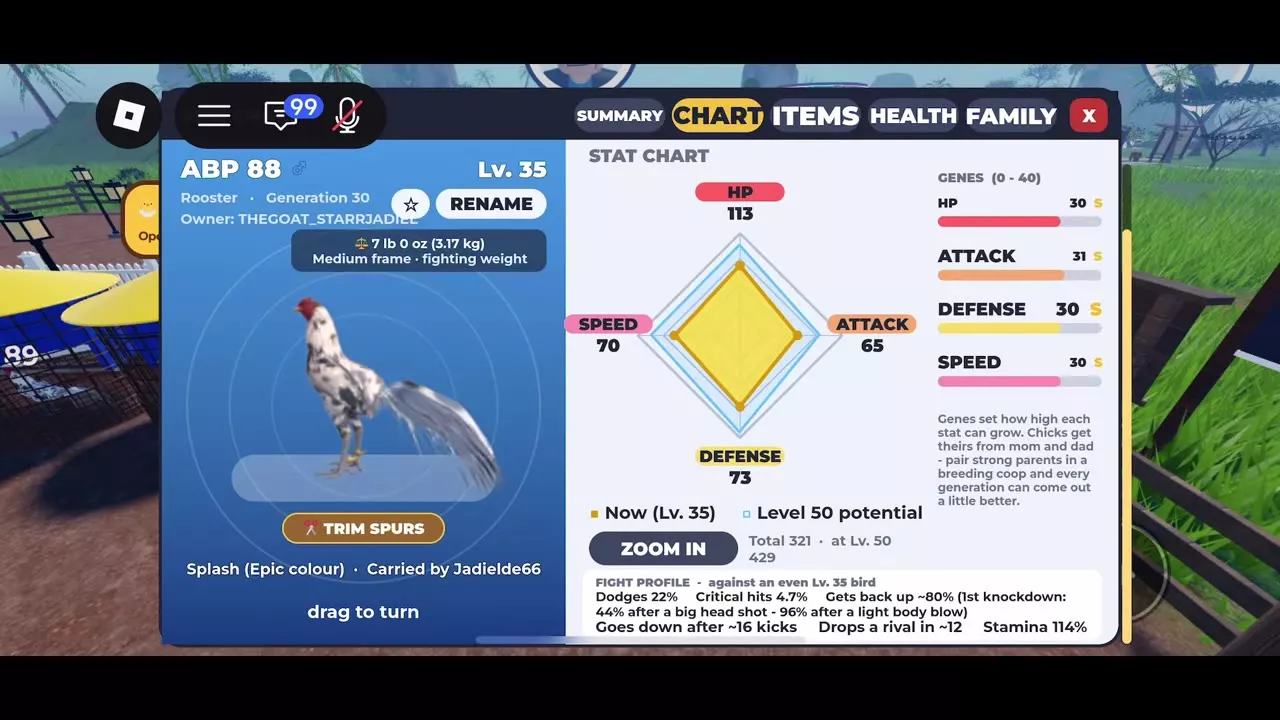
ABP 88: Level 35 configuration
ABP 88 is a Generation 30 bird with the Stubborn temperament and Leg Assassin fighting style.
| Stat | Current value | Gene | Grade |
|---|---|---|---|
| HP | 113/113 | 30/40 | S |
| Attack | 65 | 31/40 | S |
| Defense | 73 | 30/40 | S |
| Speed | 70 | 30/40 | S |
Stubborn gives +10% Defense and −10% Attack. This configuration has 36,487 XP, with 837 remaining to the next level.
CHART gives a current attribute total of 321 and Level 50 potential of 429: a difference of 108. That difference compares the two displayed totals; it is not a per-level growth rate.
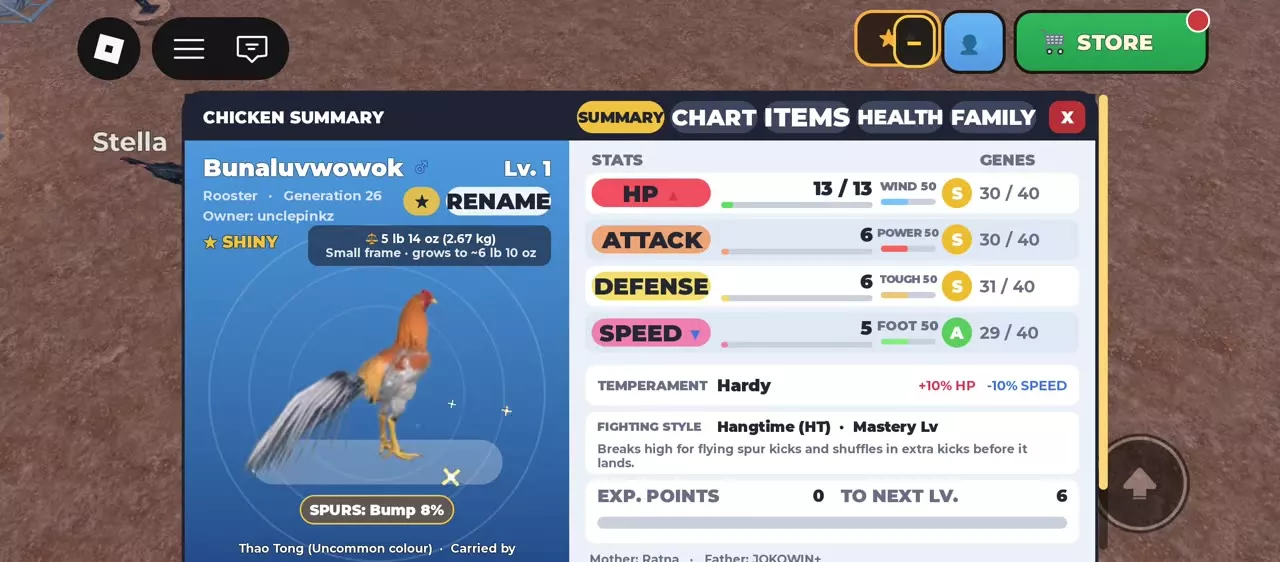
Bunaluvwowok: Level 1 configuration
Bunaluvwowok is a Generation 26 bird with the Hardy temperament and Hangtime fighting style.
| Stat | Current value | Training bar | Gene | Grade |
|---|---|---|---|---|
| HP | 13/13 | WIND 50 | 30/40 | S |
| Attack | 6 | POWER 50 | 30/40 | S |
| Defense | 6 | TOUGH 50 | 31/40 | S |
| Speed | 5 | FOOT 50 | 29/40 | A |
Hardy gives +10% HP and −10% Speed. This configuration has 0 XP, with 6 remaining to the next level. Its low current numbers belong to a Level 1 bird; read the gene column separately when judging its growth potential.
Fight Profile predictions
Select CHART and read Fight Profile beneath the radar chart. Its predictions compare your bird with an opponent of the same level. They cover dodge chance, critical chance, recovery after a knockdown, hits endured, attacks needed to knock down the opponent and stamina.
For the Level 35 ABP 88 configuration above, the comparison is against a Level 35 opponent:
| Prediction | Value |
|---|---|
| Dodge chance | 22% |
| Critical chance | 4.7% |
| Knockdown recovery | Approximately 80% |
| Kicks endured before falling | Approximately 16 |
| Attacks to knock down opponent | Approximately 12 |
| Stamina | 114% |
These are predictions for that bird and comparison. Use them to assess its balance of avoidance, endurance and offensive pressure alongside the raw stats.
Knockdown strength and location
Recovery depends on the blow that knocks the bird down. ABP 88’s first-knockdown comparison gives 44% recovery after a hard head hit and 96% after a light body hit. The approximately 80% recovery figure does not replace those blow-specific conditions.
A knockdown still gives the bird a chance to get back up. For the recovery sequence and match outcome rules, see automatic combat, recovery and judges.
Weight and lifelong frame
Open INSPECT and read the weight, frame and weight-status label beside the bird. For a growing bird, also check its projected grown weight.
Heavy versus light birds
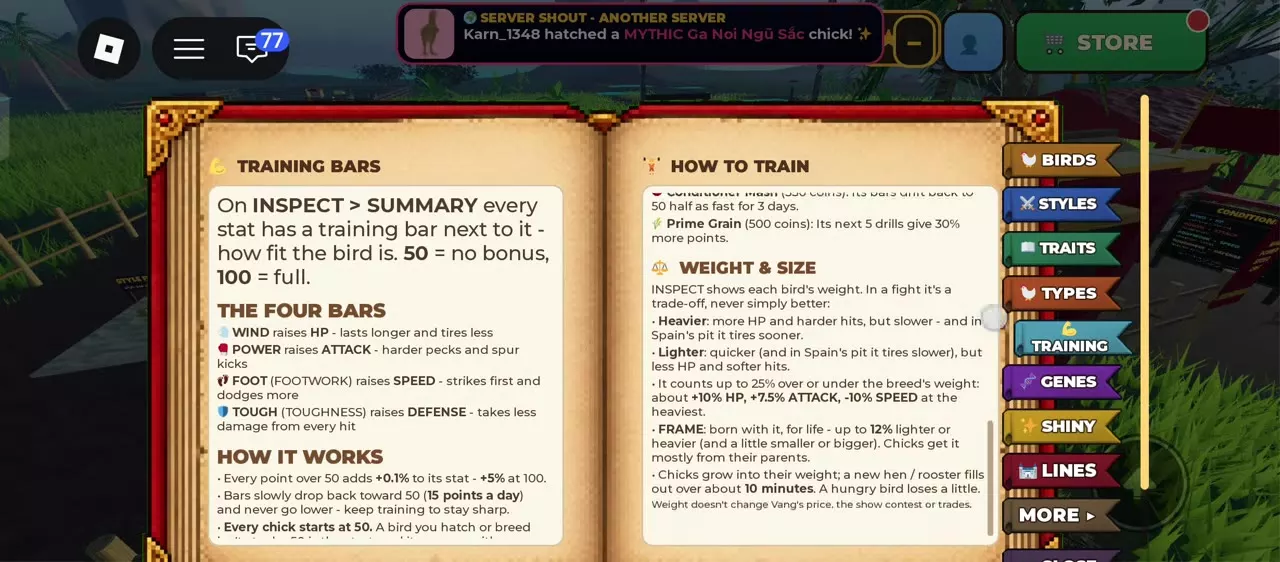
- Heavier birds: more HP and stronger attacks, with lower Speed. They also tire sooner in Spain’s fighting pits.
- Lighter birds: higher Speed and slower fatigue in Spain, with less HP and weaker attacks.
Choose a heavier bird when you favor damage endurance and harder hits. Choose a lighter bird when you favor Speed and slower fatigue in Spain. Read the bird’s weight status alongside its combat stats to judge that tradeoff.
Combat weight differences count up to 25% above or below the breed standard. At the heaviest end, the effects are approximately +10% HP, +7.5% Attack and −10% Speed. Compare weight relative to the breed standard rather than treating one absolute weight as the target for every bird.
Lifelong frame and growth
FRAME is the bird’s lifelong body size. It shifts weight by up to 12% lighter or heavier and makes the bird slightly smaller or larger. A chick’s frame mainly comes from its parents.
A new hen or rooster takes approximately 10 minutes to fill out to its own weight. Hungry birds lose a little weight. Weight does not change sale prices, show competitions or trading.
Individual weight examples
| Bird | Level | Frame | Current weight | Status or grown weight |
|---|---|---|---|---|
| Bunaluvwowok | 1 | Small | 5 lb 14 oz / 2.67 kg | Grows to approx. 6 lb 10 oz |
| ABP 88 | 35 | Medium | 7 lb 0 oz / 3.17 kg | Fighting weight |
| 76 | 21 | Big | 7 lb 5 oz / 3.31 kg | Fighting weight |
| Anthekasheng | 1 | Big | 7 lb 13 oz / 3.55 kg | Heavy: +power, −speed |
| Wowox | 22 | Large | 8 lb 0 oz / 3.64 kg | Heavy: +power, −speed |
Frame and current weight describe different parts of the bird. A Big-frame bird such as 76 has a fighting-weight label, while Anthekasheng also has a Big frame but carries a heavy label. Use the current status and, for a growing bird, the projected weight when making your comparison.
Develop your bird
- Leveling and missing XP: raise the bird’s level through fights or farm training, and resolve food or water problems that block XP.
- Conditioning training: improve WIND, POWER, TOUGHNESS and FOOTWORK to boost their corresponding combat stats; manage training energy and conditioning decay.
- Temperaments and hidden talents: compare temperament stat gains and losses, then reveal talent effects. Stubborn and Hardy demonstrate why a boost must be read alongside the stat it reduces.
- Genes, grades and inheritance: understand the four gene values that shape growth potential and how parents pass genes to chicks.