Rooster Rivals Genes, Grades and Inheritance
Genes shape a bird’s growth potential and help you compare future breeding parents. Read all four values alongside their grades to see where a bird’s strengths lie.
Each bird has HP, Attack, Defense and Speed genes rated from 0 to 40. A chick inherits one hidden gene copy for each attribute from each parent, and small mutations can raise or lower the result.
Four genes and growth potential
Each gene affects how high its corresponding attribute can grow:
- HP: health growth potential.
- Attack: attack growth potential.
- Defense: defense growth potential.
- Speed: speed growth potential.
Each gene has a value from 0 to 40. A gene value describes potential; the current attribute is the bird’s present stat. For a closer look at current stats and the Level 50 projection, see stats and fighting weight.
Read grades in SUMMARY and CHART
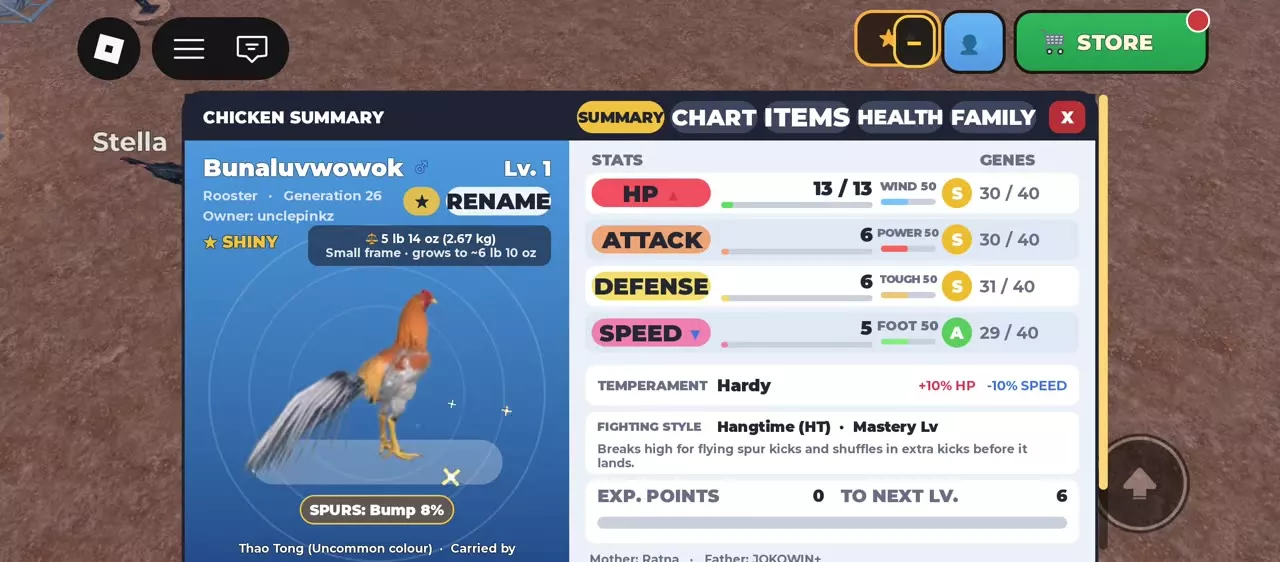
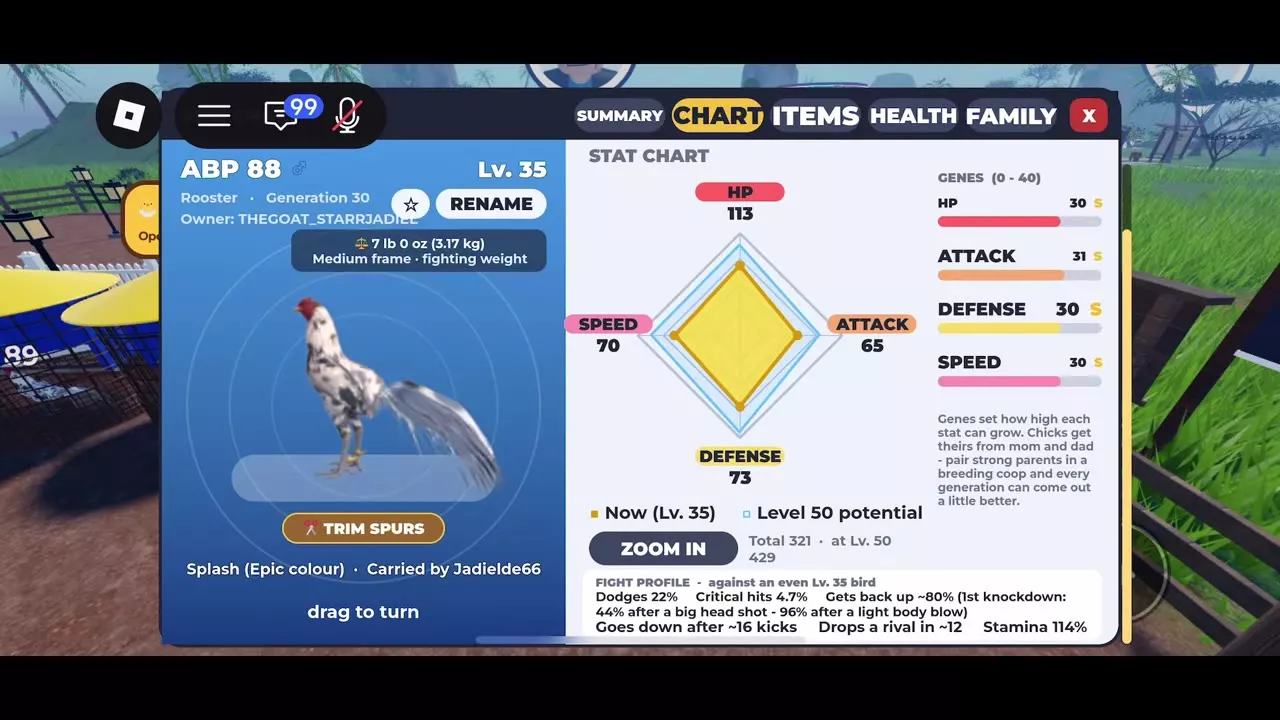
Open a bird’s inspection interface and select SUMMARY. Each stat row shows the current attribute and a separate gene value with its letter grade. Select CHART to see all four genes beside the comparison of current stats and Level 50 potential.
For example, the Level 35, Generation 30 rooster ABP 88 has S-grade genes of 30/40 HP, 31/40 Attack, 30/40 Defense and 30/40 Speed. The Level 1, Generation 26 rooster Bunaluvwowok has S grades at 30/40 HP, 30/40 Attack and 31/40 Defense, with an A grade at 29/40 Speed. SS and SSS are also gene grades.
Hidden copies and mutation
Each attribute has two hidden gene copies. A chick inherits one copy from its mother and one from its father. Small mutations can change the result in either direction.
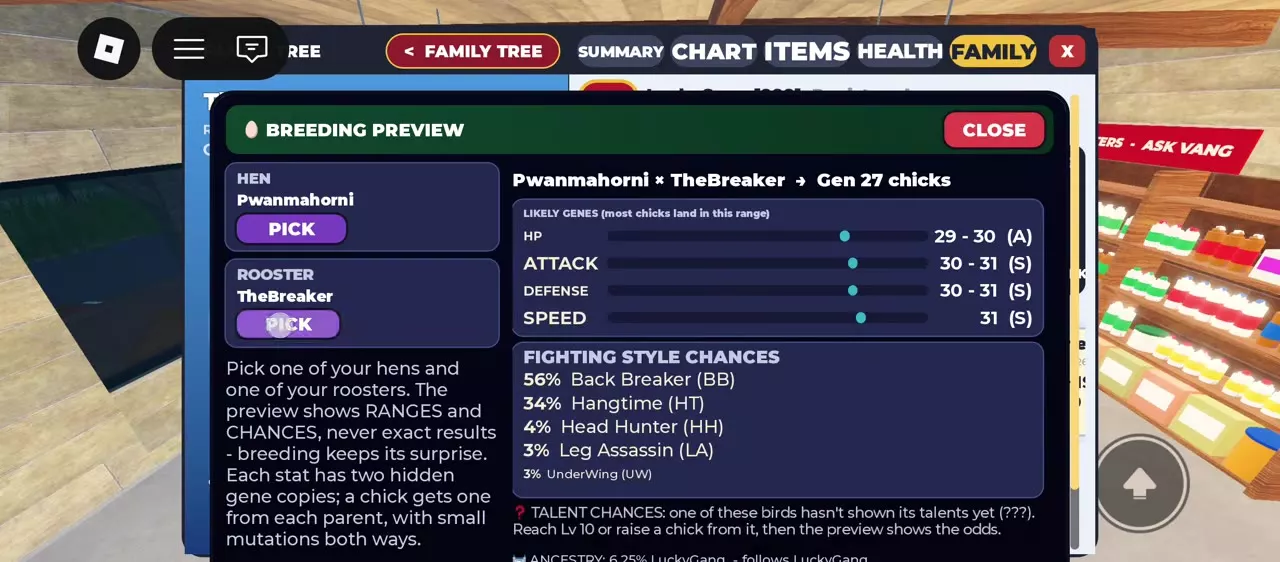
Breeding Preview displays likely gene ranges and chances for a selected pair, not an exact result for every chick. For example, Pwanmahorni and TheBreaker’s preview gives HP 29–30, Attack 30–31, Defense 30–31 and Speed 31 for their Generation 27 chicks. Inspect a chick’s own genes after hatching to see its actual values.
Apply genes to parent selection
Compare all four genes when choosing parents, rather than picking a bird for one strong grade alone. Prioritize the attributes you want to improve while checking whether the other three fit your goal. Compare the predicted ranges for the pair, then inspect the offspring before selecting the next generation.
The breeding guide covers choosing parents, comparing previews and selecting offspring.